Last time I was complaining that sometimes the post office is closed unexpectedly because of some federal holiday or other that Mrs Walles and I do not mark (not that we wouldn't be keen to mark said holidays, of course, its just that not everyone gets them off).
Now I'm going to balance things out by extolling the virtues of something that all Americans take for granted, but that to me is like magic. In America if you put outgoing mail in your mailbox, the mail man will take it away for you, with no fuss. You can have all your gilt bathrooms and antique ivory back scratchers: as far as I'm concerned this is the epitome of luxury.
I was vaguely aware of this before I came here. Movies had taught me that in the US mailboxes had a little red flag on the side that had something to do with sending mail. As a child I was deprived in the mailbox department because we had a post office box instead. But things have changed. Now I have one of those fancy American mail boxes (approved by the Postmaster General himself, no less!) complete with the little red flag. Mrs Walles and I spruced ours up last year with a fresh coat of paint. I was going to put up a photo but when I found this almost identical one on Wikipedia I decided I could save myself the trouble.
Ironically the red flag isn't necessary. You just put the mail you want to send inside in the morning and later that day you find it gone, typically replaced with screeds of glossy catalogues and fliers and the occasional bill. Every time I do it I'm tempted to put the little flag up, just to get into the spirit of the thing, but then I think twice and realise that the flag would be a signal not just to the mail man but also to any nefarious characters who wonder if any of our correspondence is worth pilfering.
At least it's still there, though, the cherry little flag, just like in the movies. Even if its duties are only ceremonial, it is nice reminder of where I am (well, that and the enormous flag the neighbours have over their door). And flag or no flag I can still send mail without setting foot off the property. Can you?
Tuesday, March 6, 2012

Tuesday, February 21, 2012
Presidents Day
Yesterday was Presidents Day in the United States, a federal holiday intended to celebrate all the presidents of this proud republic - or so I thought until I went away to check where the apostrophe goes in "Presidents Day" and discovered that not only is there no agreement on the inclusion or placement of the apostrophe, but that it isn't even the official name of the holiday. According to the relevant federal law the holiday celebrates the birthday of George Washington, and although a number of states have it on their books as Presidents Day (with varying punctuation and ambiguous meaning) it is only convention that establishes the name nationwide.
This is just one of the perplexing things about American holidays. In New Zealand the the public holidays are, if not exactly mandatory, then delivered with a strong hint from the labour laws that everyone gets the day off. Here there are a number of federal holidays - but those are technically only holidays for federal government workers. The individual states declare their own state holidays, many of which coincide with the federal ones, but again these only technically apply to state government workers. By convention at least some of those holidays are also taken by workers in the private sector, though your mileage may vary. Mrs Walles, for one, did not get the day off yesterday.
There are a few holidays, like Independence Day and Thanksgiving that seem sacrosanct, but the rest often fall by the wayside. There's little motivation to mark a holiday which isn't really a holiday, so you forget and treat it like just another day. Which is all well and good until you go down to the post office with that urgent parcel...
This is just one of the perplexing things about American holidays. In New Zealand the the public holidays are, if not exactly mandatory, then delivered with a strong hint from the labour laws that everyone gets the day off. Here there are a number of federal holidays - but those are technically only holidays for federal government workers. The individual states declare their own state holidays, many of which coincide with the federal ones, but again these only technically apply to state government workers. By convention at least some of those holidays are also taken by workers in the private sector, though your mileage may vary. Mrs Walles, for one, did not get the day off yesterday.
There are a few holidays, like Independence Day and Thanksgiving that seem sacrosanct, but the rest often fall by the wayside. There's little motivation to mark a holiday which isn't really a holiday, so you forget and treat it like just another day. Which is all well and good until you go down to the post office with that urgent parcel...
Wednesday, January 25, 2012
Of leaves and squirrels
A couple of weeks ago Mrs Walles and I were preparing to go out when we spotted Myrtle the squirrel out on the back deck clutching a wad of dead leaves in her mouth.
 The squirrels collect these to pad their nests with. We've watched them collecting leaves before, shuttling back and forth from their nests redecorating (often several of them share a nest). Myrtle wasn't shuttling, though, she was looking at me earnestly and sitting quite still. When I put some nuts out, she hopped down and dropped the leaves before making off with a snack.
According to the experts a lone squirrel looking for shelter on a cold night will sometimes bring a wad of leaves as an offering to an already occupied nest. It's pleasant to think that Myrtle was bringing us a little present in return for the (vast quantities of) nuts we give her. Alas I think the answer is much simpler: she was probably up the hill gathering some leaves for nest, spotted us moving in the house, and hurried down to ask for something to tide her over without even stopping to dump the leaves. After all, I'm sure with all the interior decorating she'd been doing that she'd worked up quite an appetite!

According to the experts a lone squirrel looking for shelter on a cold night will sometimes bring a wad of leaves as an offering to an already occupied nest. It's pleasant to think that Myrtle was bringing us a little present in return for the (vast quantities of) nuts we give her. Alas I think the answer is much simpler: she was probably up the hill gathering some leaves for nest, spotted us moving in the house, and hurried down to ask for something to tide her over without even stopping to dump the leaves. After all, I'm sure with all the interior decorating she'd been doing that she'd worked up quite an appetite!
Wednesday, January 4, 2012
Nutty as fruitcakes
Christmas has come and gone, absorbing more of my time than I would really have liked, principally in preparing far more food than is good for me. Anyway, that's why I haven't had an opportunity to post during the festive season.
One of the reasons Christmas cooking takes so much of my time is that I find myself making some things that are traditional for Mrs Walles and some that are traditional for me. I grew up eating fairly conventional New Zealand Christmas fare: ham, new potatoes, peas and carrots along with a roast, usually pork in our case but occasionally lamb. So my first American Christmas (I've had three here now, but this last one was the first in my own home) was quite a culture shock with only one point of similarity (the ham). Mrs Walles comes from Italian-American stock and so pasta figured heavily in that first Christmas dinner - not that I was complaining, mind you, as it was all excellent, but it was certainly different from what I was used to.
One of the most remarkable of all the American festive food quirks, I find, is the widespread distaste for Christmas cake, or indeed fruit cake of any kind. There is an annual competition, in Texas I believe, where fruit cakes of all shapes and sizes are lobbed by catapults to see who can hurl theirs the furthest, and my own polling indicates that many if not most Americans agree that's the only thing they are good for.
For two Christmases I was baffled. I was used to seeing Americans turning up their noses at foods they were unfamiliar with, but I couldn't understand this wholesale revulsion to such an inoffensive food. I'm well aware that not everyone in the fruitcake-eating regions of the world likes the stuff, but in America fruitcake is a kind of joke. But what really got me was that when I made my own Christmas cake, using the hallowed family recipe that never fails, the result just didn't appeal like it usually did. So unappealing was it that, even coated in a thick layer of brandy icing, most of the cake would end up in the bin shortly after New Year's Day. Was there something in the air?
But now I understand. Clearly lingering jet lag from long pre-Yuletide flights had clouded my reason over those two Christmases past. Careful investigation this year led me to discover that what is labelled "mixed fruit" here, and which is trotted out for sale as the holidays approach, is not mixed fruit as I know it. Mixed fruit should be heavy on the sultanas and raisins, but the stuff commonly available here contains not a single dried grape. Instead it contains candied pineapple and something called citron, which is the candied peel of a green citrus fruit which must taste something like a lime in the flesh. Neither is conducive to a good fruit cake, making it overly sugary sweet and dense with an off-putting flavour.
This year I purchased my dried fruits individually and mixed them myself (not a trivial matter as it turned out - the mixed peel had to come by mail order from a British food importer).

The cake that emerged from the oven this year is just as I remember it. Even Mrs Walles, long an opponent of fruit cake, had to admit that it was palatable, especially without the citron.
And so I think I've probably solved the mystery. I reckon that American fruit cake has such a bad reputation because it is made with the wrong kind of fruit. I can't imagine how this state of affairs came about. Maybe fruit cake devotees here couldn't get the best ingredients and had to make do. Maybe revolting fruit cakes were deliberately baked during the revolution to scare the British away. I don't know, but it doesn't matter. Its enough that I know I can make good fruit cake here myself. And in the unlikely event that I'm offered a slice of the genuine American article, I should probably politely decline.
One of the reasons Christmas cooking takes so much of my time is that I find myself making some things that are traditional for Mrs Walles and some that are traditional for me. I grew up eating fairly conventional New Zealand Christmas fare: ham, new potatoes, peas and carrots along with a roast, usually pork in our case but occasionally lamb. So my first American Christmas (I've had three here now, but this last one was the first in my own home) was quite a culture shock with only one point of similarity (the ham). Mrs Walles comes from Italian-American stock and so pasta figured heavily in that first Christmas dinner - not that I was complaining, mind you, as it was all excellent, but it was certainly different from what I was used to.
One of the most remarkable of all the American festive food quirks, I find, is the widespread distaste for Christmas cake, or indeed fruit cake of any kind. There is an annual competition, in Texas I believe, where fruit cakes of all shapes and sizes are lobbed by catapults to see who can hurl theirs the furthest, and my own polling indicates that many if not most Americans agree that's the only thing they are good for.
For two Christmases I was baffled. I was used to seeing Americans turning up their noses at foods they were unfamiliar with, but I couldn't understand this wholesale revulsion to such an inoffensive food. I'm well aware that not everyone in the fruitcake-eating regions of the world likes the stuff, but in America fruitcake is a kind of joke. But what really got me was that when I made my own Christmas cake, using the hallowed family recipe that never fails, the result just didn't appeal like it usually did. So unappealing was it that, even coated in a thick layer of brandy icing, most of the cake would end up in the bin shortly after New Year's Day. Was there something in the air?
But now I understand. Clearly lingering jet lag from long pre-Yuletide flights had clouded my reason over those two Christmases past. Careful investigation this year led me to discover that what is labelled "mixed fruit" here, and which is trotted out for sale as the holidays approach, is not mixed fruit as I know it. Mixed fruit should be heavy on the sultanas and raisins, but the stuff commonly available here contains not a single dried grape. Instead it contains candied pineapple and something called citron, which is the candied peel of a green citrus fruit which must taste something like a lime in the flesh. Neither is conducive to a good fruit cake, making it overly sugary sweet and dense with an off-putting flavour.
This year I purchased my dried fruits individually and mixed them myself (not a trivial matter as it turned out - the mixed peel had to come by mail order from a British food importer).

The cake that emerged from the oven this year is just as I remember it. Even Mrs Walles, long an opponent of fruit cake, had to admit that it was palatable, especially without the citron.
And so I think I've probably solved the mystery. I reckon that American fruit cake has such a bad reputation because it is made with the wrong kind of fruit. I can't imagine how this state of affairs came about. Maybe fruit cake devotees here couldn't get the best ingredients and had to make do. Maybe revolting fruit cakes were deliberately baked during the revolution to scare the British away. I don't know, but it doesn't matter. Its enough that I know I can make good fruit cake here myself. And in the unlikely event that I'm offered a slice of the genuine American article, I should probably politely decline.
Thursday, December 15, 2011
Philly Cheesesteak
My only experience of Philadelphia so far has been from the inside of a train station, but thanks to a friend of ours who is a native we recently got to sample its most famous culinary creation, the cheesesteak. This is a sandwich (in the American sense, which encompasses a broad church of bread-based foods, in this case it means it comes on a long roll) filled with thinly sliced steak and cheese, at the very least, with added extras depending on who makes it.
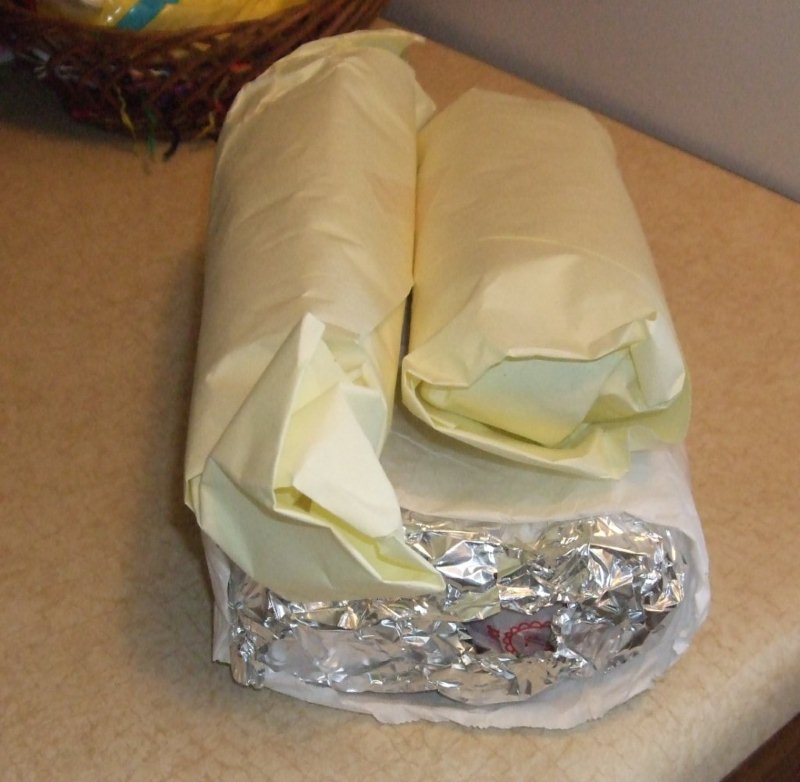
Our friend was kind enough to bring us two different kinds, one from Pat's, which has widespread reputation for good cheesesteaks (and is supposed to have been founded by one of the inventors back in the day), and one from Max's which is her personal favourite.
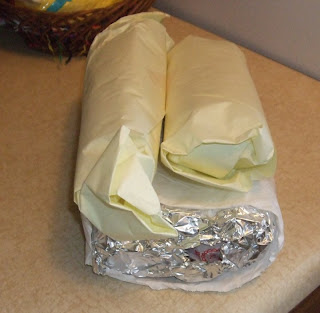 Max's was modestly wrapped in paper, Pat's was more promotional.
 Having tried both of these I can honestly say that they were both fantastic but Max's clearly blew Pat's out of the water. Apparently Pat's use processed cheese (only in America!) while Max's uses real cheese, and it really makes a difference. And while Pat's added only onions Max's added some kind of tomatoey sauce which moistened everything up delightfully. Here's a cross-section, Max's on the left, Pat's on the right.
 Max's reminded me very much of eating a good steak and cheese pie back in New Zealand, which isn't surprising because there are many similarities. Given that meat pies are almost entirely lacking in this part of the world, it's obvious that things like the cheesesteak fill the gap.
It's also clear that the City of Brotherly Love knows what its doing. I've ordered cheesesteaks before in other parts of the country, even the state, and the genuine article is just in a league of its own. I certainly know what I'll be eating next time I go to Philadelphia!
Our friend was kind enough to bring us two different kinds, one from Pat's, which has widespread reputation for good cheesesteaks (and is supposed to have been founded by one of the inventors back in the day), and one from Max's which is her personal favourite.


It's also clear that the City of Brotherly Love knows what its doing. I've ordered cheesesteaks before in other parts of the country, even the state, and the genuine article is just in a league of its own. I certainly know what I'll be eating next time I go to Philadelphia!
Saturday, December 10, 2011
The plumbing strikes back
I had been going to end the last post by noting that when the Amish fix something, it stays fixed. Alas our toilet seems to have the devil in it, for not a day had elapsed after they left before it started playing up again. We've been on to the landlord and have received instructions that Hosea (which I now learn is the satisfyingly exotic name of our erstwhile and taciturn plumber) will appear sometime next week to have another go.
I hope he brings his bible as well as replacement valves, just in case there is more than rust at work and he has to exorcise demonic forces from the cistern.
I hope he brings his bible as well as replacement valves, just in case there is more than rust at work and he has to exorcise demonic forces from the cistern.
Thursday, December 1, 2011
The Return of the Amish
The Amish are back again. Long time readers will recall that they fixed our deck earlier in the year. Now they're back to fix our screen door, some drainage difficulties out the back, and an unrelated problem with the flush in the downstairs toilet (or "half-bathroom" as they're called here, despite not containing a bath). For thirty years of my life these people might as well have been from a fairy tale, now they're fixing my toilet. I'm not sure what to make of that.
I'm writing this post to take a break from writing about the next big thing in high speed wireless communications. Somehow it feels a bit wrong doing that while these famous eschewers of the electric age are downstairs fixing the door. Admittedly I'm still using a computer as I write this, but at least the subject matter isn't adding insult to injury. Anyway, I hear the fellow downstairs using his electric drill and possibly even a cell phone...so my overactive conscience is somewhat assuaged.
Unlike last time when they swept in and out with barely a word, this time I have had to interact with them to explain the plumbing difficulties. I had been going to write - and indeed had just written before I erased it - that these Amish workmen seem cold and unfriendly. But I've just this minute been on a hunt in the basement for the main water valve (turned out it was hidden behind some slapped-together walls) and I think I should revise that. Taciturn and quiet, yes. But not out of hostility, I think, just as a way of using as few words as possible. They've got a job to do, you know. Mind you, they don't say hello or goodbye. I don't know their names, they come and go without a word. So maybe not cold, but certainly rather chilly.
It's an interesting experience, trying to learn about a people from the way they mend your house, and a technique that anthropologists would no doubt frown upon as full of methodological flaws. It's the only one I've got, though, so I'll have to stick with it even if it leaves me with more questions than answers.
I'm writing this post to take a break from writing about the next big thing in high speed wireless communications. Somehow it feels a bit wrong doing that while these famous eschewers of the electric age are downstairs fixing the door. Admittedly I'm still using a computer as I write this, but at least the subject matter isn't adding insult to injury. Anyway, I hear the fellow downstairs using his electric drill and possibly even a cell phone...so my overactive conscience is somewhat assuaged.
Unlike last time when they swept in and out with barely a word, this time I have had to interact with them to explain the plumbing difficulties. I had been going to write - and indeed had just written before I erased it - that these Amish workmen seem cold and unfriendly. But I've just this minute been on a hunt in the basement for the main water valve (turned out it was hidden behind some slapped-together walls) and I think I should revise that. Taciturn and quiet, yes. But not out of hostility, I think, just as a way of using as few words as possible. They've got a job to do, you know. Mind you, they don't say hello or goodbye. I don't know their names, they come and go without a word. So maybe not cold, but certainly rather chilly.
It's an interesting experience, trying to learn about a people from the way they mend your house, and a technique that anthropologists would no doubt frown upon as full of methodological flaws. It's the only one I've got, though, so I'll have to stick with it even if it leaves me with more questions than answers.
Subscribe to:
Posts (Atom)