Showing posts with label wildlife. Show all posts

Friday, June 27, 2014

Woodpecker

I had thought I'd catalogued all the back yard birds around here - at least the ones that would sit still and pose for a photo - but it turns out I was wrong.  Not long ago I managed to capture this chap digging into a dead tree behind our house.
That's a pileated woodpecker (you can tell it's a male from the red moustache and forehead).  There's species of woodpeckers around and about, some of which I've blogged about before.  The pileated kind aren't the most colourful or even the most friendly they are the largest and probably best known species.  When casting agencies get asked for a woodpecker, these are the guys they send over.
I've seen a few of these over the years, but I'd come to assume they were quite timid.  It turns out I must have only spotted younger birds before: this one was huge by comparison - as big as a small chicken - and not timid at all.  I was able to creep (not very stealthily) up to the base of the tree he was pecking and he didn't even flinch.
Thinking about it now, I realise it's a good thing he didn't take exception to me - I wouldn't like to end up on the business end of his beak, now that I've seen how easily they chisel big chunks out of wood.  Perhaps I was lucky he didn't decide to have a go at chiselling big chunks out of me?  The risks I take for the perfect shot!

Thursday, March 14, 2013

Oh deer!

It's a bit of a dull time of year for backyard wildlife in Pennsylvania.  There are the ever-present squirrels of course, and the sturdier birds like blue jays, titmice and wrens stay throughout the winter (so do the cardinals, usually, though they haven't been around as much recently - perhaps they were called to Rome) but groundhogs, chipmunks and most of the birds are mostly still slumbering or sunning themselves in more equatorial climes.

I understand of course.  I can slumber with the best of them in the winter and I was recently sunning myself in a more equatorial clime and it was most agreeable - more on that soon.  But it does make the backyard naturalist  pine for the summer months when you never know what exotic (at least to a Kiwi) creature is going to amble into your life.

So I was very excited this morning when a pair of deer ambled - or rather ran - across the yard.  It was pure chance that I spotted them out the back window: I wouldn't usually be looking out at that time and for all I know they wander through every day.  It's not the first time I've seen deer locally, or even in the backyard, but previous sightings from the house have all been during early evening and it was very striking to see them on our hill in full daylight.

It was a brief encounter, but I will be on the lookout for them again.  Along with changes to the weather they gave me hope that spring is really on the way.  Hopefully its not deer today and gone tomorrow.

Saturday, June 30, 2012

The pitter-patter of tiny, tiny feet

In one corner of our front garden (which is coming along quite well, thank you) there used to live a very elusive creature.  I say "used to" because I'm pretty sure he has moved on, either to the hereafter or to somewhere where I'm not constantly weeding and digging and generally caving in the ceiling of his house.  I still take care to wear gloves when I'm doing that though, for reasons that will become obvious.

I first spotted him late last year. I happened to be standing on the front steps admiring the quiet when the quiet was broken by the sound of something scuffling around in the garden bed.  On closer examination, and with the help of a book, I  discovered that it was a shrew.
It's the little grey blur in the centre of the photo above.  Shrews are tiny, fast and look like little moles (which, oddly enough, I still haven't seen in person).  They like to nest under things, and this one had a hole leading to a nest which I presume was under our front steps.  He would then run along from his home to the conifer at the other end of the flower bed where the pickings were apparently rich for a shrew.  Sometimes he would run along a kind of half-open tunnel he had made beside the stones lining the bed.  Other times he would run just beneath the surface of the soil in the bed, making a little moving ripple of dirt and leaves like something out of a sci-fi movie.

Shrews are fairly common but not often seen, from what I understand.  They stay under the surface of the soil most of the time, and lead very fast-paced and short lives.  It was sheer good fortune that I spotted this one and was able to get even one photo of him.

I continued to see him until the late spring, a month or two ago, including a few times when I was working out in the garden.  One time he surprised me by poking his head out of his hole as if to ask what the heck was going on.  He certainly wasn't timid about challenging me.  Which brings me to the gloves.  Cute and furry as he is, it turns out that saliva of these shrews is mildly poisonous. Not enough to make you keel over but certainly enough to make it a bad day if you get bitten.  That threat, along with all the other unfamiliar creatures I might unexpectedly disturb while planting out my annuals, is quite enough to ensure that I always wear gloves when working outside.

Thursday, May 31, 2012

Bachelor pad

Back in January I posted a picture of a Myrtle the squirrel collecting leaves to pad her winter nest with.  As the weather is warming up the squirrels have been moving from their nests inside hollow trees to their summer digs, big leafy affairs high in the canopy.  Usually you can't even see these until the autumn when the leaves drop and reveal the locations of the dreys, as they are officially called.

This year, though, it happened that three squirrels decided to build one in a tree behind our house that fortuitously happened to be in direct line of sight from our back door.  At least I assume it is fortuitous.  Maybe they planned it that way, but from their point of view the back door is in direct line of sight of the drey and they can see whether we've put any nuts out for them just by poking a head out of the nest!
Squirrel drey
It's still a little hard to see, but the drey is the bundle of green leaves around the fork in the tree near the centre of the picture above.  Here's a closer look.
Squirrel near drey
I happened to notice the construction project going on early one Friday morning and as I checked throughout the day I could see at least three different squirrels cutting leaves and bringing them back to stuff inside the nest and pad it out.  There is one in the photo above, in fact, off to the left of the nest.
Squirrel near drey highlighted
They all seemed to be males, from a group Mrs Walles and I have been calling the interlopers since they only turned up on our patch this year.  Mixed-sex nesting is not unknown among squirrels, apparently, but as the spring comes on the females like to have nests to themselves to bring up their young.  I suspect that the interlopers, finding themselves homeless, banded together to build themselves a bachelor pad.  It's still there, shaded by the trees, no doubt a very pleasant summer home for the crew who built it.

Thursday, March 29, 2012

Great Horned Owl

Spring has come very early for most of the United States this year, so Mrs Walles and I have turned the heating off.  This is one of my favourite times of the year because we can open the doors and windows and let the fresh air in, instead of staying cocooned inside with either the air conditioning or the heat running (essential though they may be for comfort in summer and winter).

Last week was particularly warm with summery temperatures that lasted through the night and so we had our door open late in the evening, and one night during a break in the noise from the television we noticed an unusual sound coming from outside. Mrs Walles, who is of course more familiar with such things, soon identified it as an owl.

Now I am aware that New Zealand is not without owls, like the morepork or the world-conquering barn owl (which is also found here in Pennsylvania).  But they have nothing on what we were listening to (you can hear a recording I made here), as I discovered when I flicked through my field guide.

This was the call of the Great Horned Owl, a nocturnal bird of prey that grows half a metre high.  It eats cats - not exclusively, of course, but it gives you an idea of what we're dealing with.  It's not the kind of thing you'd want to run into on a dark night (which is of course exactly when you would run into it) and it knows it, too, judging by the expression of disdain it wears in all the photos I've seen.

This hooting normally ends by Christmas so we were quite fortunate to hear the call, or rather calls because what we heard was a duet.  One owl was not far from our house and another was responding from some distance away, and the call is used to establish territory...perhaps our two late callers had been encroaching on each other's turf and were trying to sort things out.  We were doubly lucky to hear it, really, since normally the double-glazed doors and windows would all be shut and we'd be oblivious.  I realise now that they probably hoot all through the night in November and I've just never heard it because the double glazing muffles most sound and the constant buzz of heating systems drowns out the rest.

Anyway, I'm very glad to have heard an owl at last.  Don't expect me to go out trying to get any pictures myself, though.  I'd worry that a particularly ambitious one would swoop in for the kill, and I'd return either missing a scalp or with a surplus owl attached to my head.  No, owl hunting is for the birds, if you ask me.

Wednesday, January 25, 2012

Of leaves and squirrels

A couple of weeks ago Mrs Walles and I were preparing to go out when we spotted Myrtle the squirrel out on the back deck clutching a wad of dead leaves in her mouth.
The squirrels collect these to pad their nests with.  We've watched them collecting leaves before, shuttling back and forth from their nests redecorating (often several of them share a nest).  Myrtle wasn't shuttling, though, she was looking at me earnestly and sitting quite still.  When I put some nuts out, she hopped down and dropped the leaves before making off with a snack.

According to the experts a lone squirrel looking for shelter on a cold night will sometimes bring a wad of leaves as an offering to an already occupied nest.  It's pleasant to think that Myrtle was bringing us a little present in return for the (vast quantities of) nuts we give her.  Alas I think the answer is much simpler: she was probably up the hill gathering some leaves for nest, spotted us moving in the house, and hurried down to ask for something to tide her over without even stopping to dump the leaves.  After all, I'm sure with all the interior decorating she'd been doing that she'd worked up quite an appetite!

Friday, October 14, 2011

A story with legs

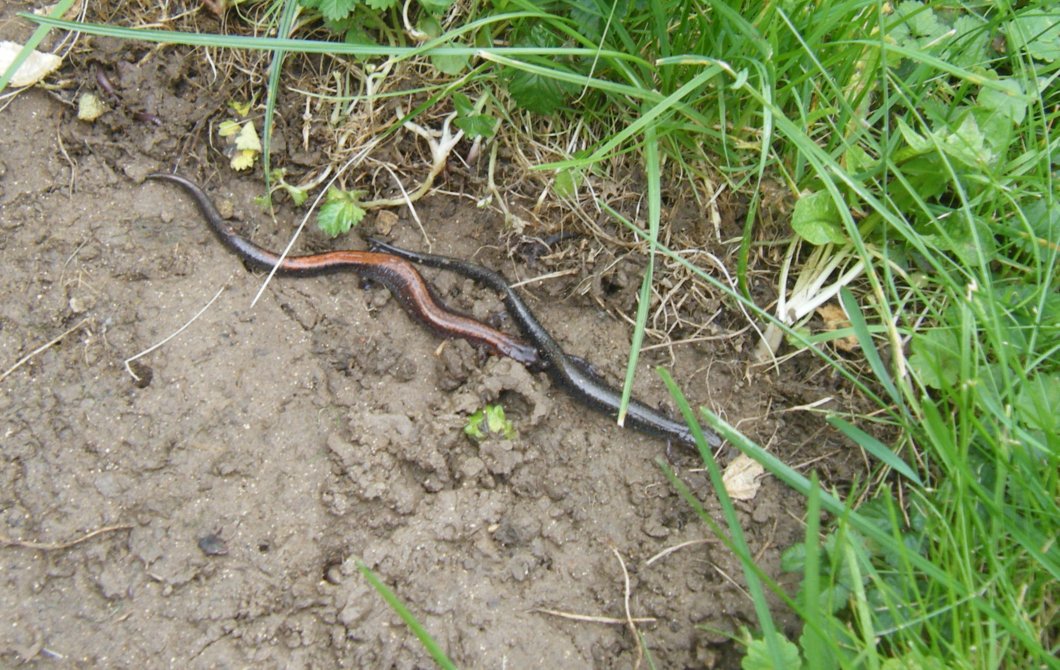
The other day I decided to finally resow the grass under an old rubber mat we had been using on the lawn.  I've become accustomed to lifting the mat up when I mow so I was expecting there to be an assortment of the kinds of creepy crawlies that live under rocks and old rubber mats.  This time, though, the bounty was truly prodigious.  As well as the occasional beetle and earthworm, there were a few leeches and some enormous, fat worms.  As soon as they were exposed to daylight, most of these headed for the safety and darkness of their various underground lairs.  But two or three of the huge worms didn't really move - until one of them lifted itself up on its legs and scurried off.
Now I'm not much of a naturalist, but truth that I will cling to in a storm is that worms don't have legs.  For a moment I thought I'd uncovered some kind of unearthly hell-beasts.  Then I wondered if the chipmunks had started evolving to better suit the increasingly aquatic environment outside our back door.  But then I realised that these ten centimetre long creatures were salamanders, tiny amphibians, land-lubber cousins of the much more spectacular hell bender that lives in the waterways here.
There are a number of varieties found here according to my references.  Not something we have in New Zealand outside of high-school science labs, really.  I'm not sure exactly what species these are but from what I've read land-dwelling salamanders don't have lungs, instead absorbing oxygen through their skin.  That means they don't have to move to breathe, of course, which no doubt helped the initial illusion that they were worms.  Some of them also have that neat trick of dropping their tail when startled, to distract predators, though all tails seemed to stay attached this time.

I left them alone for a while and when I came back to sow the grass seed they'd obviously found their way to safety.  An interesting and exciting encounter, but one which reminds me I have to take more care when investigating nooks and crannies over here.  It was just some harmless salamanders this time, but there are nastier things that lurk in dark corners that I'd really rather avoid.

Thursday, September 1, 2011

The Squirrels

The last couple of days we've tried a different tack with putting nuts out for the squirrels.  Instead of throwing out great handfuls of nuts at once, which attracts a big and annoying flock of blue jays, we've just been dispensing one or two at a time as demand dictates.

One of the squirrels apparently isn't too happy with this scheme.  He had figured out that he could attract my attention by jumping on a chair near the glass door.  But when I went into the next room he realised this wasn't working so decided to up the ante.  I was sitting on the couch when I heard a thump and then discovered he had climbed up the outside of the screen door.
(Incidentally, if you look very close you can see why I'm so sure he's a he.)  I'm not sure if he thought he'd be better able to attract my attention or if he just wanted a better look inside to see where Mrs Walles and I were.  It was quite adorable, though I'm now trying to discourage him from repeating the stunt in case he tears the screen.

Wednesday, July 13, 2011

Squirrel news

Remember Myrtle?
She's the squirrel that knows how to ask and waits patiently for me to see her and put nuts outside.  I think that last time I mentioned her she was pregnant.  That was some time ago and she has since had her little family - three little squirrels we believe, which began coming down to the deck with her.  They aren't so little now and some at least seem to have moved on.  It's hard to tell because when the real heat of summer arrived all the squirrels molted and their markings suddenly changed.  The only way I could recognise Myrtle was by her behaviour.  Here she is, in classic asking pose, but wearing the new season fashions.
Much sleeker and more colourful, too.  In the winter the squirrels are almost all grey, and in the summer they really go to town with the brown.

Anyway, Myrtle isn't looking quite so sleek recently and we are fairly sure she's pregnant again, so in a little while we can expect more little squirrels visiting.  I can't resist Myrtle's charm so it's a good thing that the offspring don't seem to pick up all of her asking technique or we'd go bankrupt buying nuts for the growing clan!

Tuesday, July 12, 2011

The scales lifted

The other day I saw a snake in the wild for the first time.  Mrs Walles and I were heading down to the supermarket and we passed it on the road.  Two women had stopped and seemed to be trying to encourage it off the road into a small patch of woods nearby.  A couple of things disturbed me about this.
  1. It was a big snake.  Okay, so it wasn't an anaconda, but it wasn't a teeny little grass snake either.  It was substantial, maybe a metre long or more, black and for all I knew venomous.  There is a way to tell the difference but I didn't get a good enough look at it anyway.  Anyway, even Mrs Walles thought it was a big snake, and she's lived in wilder woods than these ones.  More worrying, though, is...
  2. ...the patch of woods they were encouraging it into happens to be one that I frequent when I walk into town (which admittedly I haven't been doing nearly enough recently, and this won't help me change my ways) and which I usually wander through in my sandals smiling genially at squirrels and what-not that cross my path.
So I'll be wearing shoes from now on on my excursions, not that that would save me if I scared a dangerous snake, it's more of a psychological thing.

I've just looked up snakes and find that the tell tale signs of a venomous snake are the size and shape of its head and the shape of its pupils.  Though if I come across anything slithering in my vicinity I won't be worrying about these finer points of herpetology, I'll be finding another vicinity to be in with all possible haste.  I also find that what we saw was very likely an eastern kingsnake, a non-venomous constrictor, and that there are only three venomous species in Pennsylvania, which is somewhat reassuring.


Mrs Walles made the excellent point that dealing with a snake is just like dealing with the other wildlife here, even the cute and cuddly-looking ones.  The squirrels may be cute and all but I wouldn't want to corner one, and most of my dealings with them occur with a pane of glass between us.

So if this Kiwi comes upon any slithering beasties he'll be backing off first and asking questions later.  I imagine I'll be too surprised to do anything else. Coming from a land famously devoid of serpents, the possibility of encountering a snake just doesn't enter my mind.  If I did come across one my surprise would scarcely be greater if it started talking and offering me apples.

Monday, July 11, 2011

Mourning dove

This week's bird is one of the more interesting around here but I've held back posting about it because I wanted to record and post its call - which I haven't managed to do.  So I'll post about it anyway, on the principle that as soon as I do a perfect opportunity to record it's mournful song will arise, and then I can post about it another time.
This is a mourning dove.  It's actually quite a sweet and happy bird, but the male's call is a series of slow notes that really does sound sad.  It's very distinctive, too, so you often hear it in the cooler parts of the day even if you don't see the bird responsible.
Occasionally one or two will visit the deck, close enough for a photo.  It's pretty clear that their courtship involves a lot of standing around together like a Victorian couple, but I don't have a good shot of two together.
As far as colour goes they are a very subtle golden colour with dark spots.  A lot like a pigeon, but a little smaller and a lot better behaved.

Right, now I just need to go and record that call - should be a piece of cake now...

Thursday, July 7, 2011

Hanging out

Some time ago I posted a picture of a squirrel cooling by lying spreadeagled.   As the temperatures have been rising I've been seeing them doing it more and more.  They'll drop and cool wherever it seems convenient - on a branch, on a shady patch of grass - or quite commonly on our deck, like these two.
At least they have their summer coats on now.
Still, it's a hard life, eh?

Friday, July 1, 2011

Brown-headed cowbird

I'm quite excited about this week's bird, because I've been wanting to see one ever since I got my my field guide, and just the other day a brown-headed cowbird hove into view.
It's not particularly showy, but the picture in my field guide is of a big fluffy proud bird perched on a branch, giving the camera the eyeball, and there's something about it that I like very much.  I was surprised to find that it looks a lot like a grackle - same size, same black iridescent plumage except for the head which is a rusty beige colour.
 Despite looking I never saw one all last summer.  I had started to think that they were only to be found around livestock (they hang around cattle apparently to get at the insects and other delicacies that get raked up).  Here he was though, proving me wrong.  He was happily grazing with some grackles and I've seen them a couple of times since then.

I hope it isn't breeding, though, because it's a parasitic nester, laying its eggs for other birds to raise. I'm thinking of our nice little cardinal family, the flickers, grackles and catbirds.  It's hard enough for these birds raising their own chicks, without the added burden of a second, cowbird, family.  As long as they're just passing through and feeding they provide welcome variety, but really these cowbirds need to develop some social responsibility. 

Wednesday, June 29, 2011

Cute critters

I spent a big chunk of this morning scrubbing our deck and otherwise cleaning up after the squirrels, chipmunks and various birds that like the casual al fresco dining experience we provide.  It wasn't too bad but it's a shame they won't use the facilities.

Anyway, I got to thinking about the cuteness of my woodland friends (I say friends, but I've no doubt they'd turn on me in a moment if the nut supply dried up...) and I think I've worked out a way to measure their cuteness based on how much food you are willing to let them steal.

Take the chipmunks, for example.  One of these, which we started calling Hoover, was particularly fond of nicking seed from the bird feeder.  I even mixed in some cayenne pepper with the seed, which is supposed to deter mammals while going unnoticed by the birds.  This kept another chipmunk away, but not Hoover who apparently had a taste for the hot stuff.  I say "had" because I now think it was he, and not the little chipmunk, that was eaten by a cat a few weeks ago.  No chipmunks have been stealing seed since then.

Anyway, my point is that Hoover made of with bags and bags of sunflower seeds - chipmunks hoard tremendous amounts of food in their underground larders, something like half a bushel which is about twenty litres - and I really didn't mind.  Yes, he was being a rascal, but he was just do darned cute I couldn't really get angry at him (and I certainly didn't want him disappeared by a cat).  So judging by how much food I was willing to tolerate him stealing, Hoover's cuteness would have had the needle tapping at the end of the scale.

At the other end of the scale we have, for example, the ants that were plaguing us for a while.  They didn't actually make off with any food as far as I know, but that was still too much for us to tolerate.  Not cute at all.

And in between we find everything else.  The blue jays have been getting on our nerves because they've started hovering all the time to eat the peanuts we put out for the squirrels.  They may look good but they're not as cute as my squirelly pals.  And the bunnies are lovely to have out on the lawn - but woe betide any rabbit that eats any of my plants.

It's not a very scientific measure but it works in most cases.  I'm not sure if it still works when one cute critter eats another one - I'm not feeling any love for that chipmunk-chewing cat right now, but that's because a tiny fuzzy life has been snuffed out, not because I'm thinking of all that seed going to waste (no, really).  So it still needs some work.  I guess I'll just have to study these cute little animals some more.

Monday, June 27, 2011

House finch

This week's bird is probably the most common visitor to our feeder, apart from the sparrows, but it is also very skittish so until now I didn't have a good picture of it.  Yesterday my luck changed and I caught a house finch in the act.
This one was so cooperative, in fact, that it even did a twirl for me so that I could show you that it is only red from the front with a much duller behind.
Of course I can't be sure that it was showing off just for the camera, but it was soon joined by another one, equally gregarious.
These were both males, the females aren't red at all but just brown with white bars, though they still have the characteristic finch beak.  In the late winter we would have many of these little birds vying for a place at our feeder, but as the weather has warmed up they've paired up and started hanging out in smaller groups.  Today a little finch family visited the feeder, a juvenile and its parent, and the juvenile begged for food by flapping its wings and squawking.  The parent obliged.  It's making a rod for its own back, if you ask me.  First the grackles, now the finches.  I know that human children are becoming more and more reluctant to move out of the parental home, I didn't know it had spread to birds.  What is the world coming to?

Friday, June 24, 2011

Lights in the sky

Last night we had an impressive thunderstorm pass quite close, though it didn't actually douse us (we had to wait until this morning for that).  Much more impressive than the lightning were the lightning bugs, though.

Fireflies are a (now) familiar sight to me here in the summer.  For about two or three weeks now we've been watched them lazily fire their little yellow lights off as they buzz over the grass around twilight.  But last night was something altogether more spectacular, with hundreds, maybe thousands of fireflies sparkling in the trees outside our house and around the neighbourhood.

It's hard to explain exactly what it looked like.  My best attempt was that it was like a Christmas tree covered in flashing lights.  But I think Mrs Walles hit it on the head, saying that it was like watching camera flashes going off at a concert.

The lights looked much whiter than the usual fireflies we see, and they flashed much faster, and they were in the trees, not the grass, so I wonder if these were a different species.  Or perhaps it was larvae, hatched from eggs laid in the trees and putting on a light show for want of anything better to do.  I'm not sure what the explanation is, and I'm definitely not an expert on the matter, but it was something quite different and extraordinary.  Very flash!

Thursday, June 23, 2011

Groundhogs galore

Continuing the week's wildlife theme (and it's hard not to, the critters are so prevalent...even as I write this I'm watching a squirrel have a good old scratch on a tree bough in the back yard) here are some slightly better pictures of my neighbour the groundhog from early yesterday morning.
I had hoped they would be even better than this, but at least you can see a bit more of the body than in the shots I posted earlier.  I might have missed it altogether, it was just chance that I was staring up the hill and spotted the movement against the brush.  It wasn't until it made its way over to the lawn, though, that it started standing out well against the background, so that's the shots I've posted.
Ultimately it preferred the low brush, though, you can see it's already pining for shelter here, and it soon returned to the dense undergrowth.  Not before I got this one in a standing pose, though.
It was in sight for a long time quite close to us and it didn't scurry off when I opened the door to get a better look.  It's quite a big critter as you can see, its body alone is about the same length as a squirrel including tail. And this one is quite small.

With any luck we'll see more of our groundhog friend as the summer goes on.  In the meantime I'll content myself with the squirrel, which is now having a nice wash.  Never a dull moment!

Wednesday, June 22, 2011

Wildlife update

I couldn't deliver any pictures of the Amish hard at work raising our deck, but I did get a great picture of our female cardinal this morning, perched atop the newly levelled bird feeder, all decked out in her finery.
The groundhog was closer to the house this morning so I took more photos of it too - that  was when Mrs Cardinal (as we call her) presented herself for this shot.  I still have to go through the groundhog shots and see how they came out.  The little critter was closer than usual but that might have been cancelled out by the mist that was hanging around this morning.  If there are any good ones I'll post them soon.

Monday, June 20, 2011

Return of the groundhog

Mrs Walles and I were looking out the window the other day when we suddenly spotted something different in the trees at the top of our back yard - a groundhog! This is, amazingly, the first one that I've seen this season.  It's not as if they are uncommon, and we have even passed several on the side of the road in the car, with me missing them each time.  We've since seen this groundhog several times, though not as close as that first day.

It seems likely that it is the same one we saw last summer, since its feeding in the same places.  It is smaller than the one last year, but possibly that's because groundhogs hibernate, so they look smaller in the spring when they emerge compared to the autumn when they settle with a good supply of excess body mass to tide them over the winter.
Groundhogs are quiet little critters and they are built like tanks so that not much worries them.  Even so, they have a habit of keeping an eye out while feeding by rasing their head every few seconds to see what's going on around them.
This one wasn't too concerned by us even when we went outside to take its picture.  We were probably too far away to be perceived as a threat.
These are the best photos of our new neighbour that I have at the moment. I'm hoping it will come closer as time goes by and if I get some better pictures I'll post them here.

Sunday, June 19, 2011

Common grackle

The bird of this week is the common grackle, common by name but certainly not by nature.  These birds really stand out because, although they are jet black in dull light, their feathers are iridescent in bright light making them look blue, green and bronze.  The vivid yellow eye helps, too.
The males are slightly more flashy in their colourings than the females.  They are quite large birds, about thirty centimetres long, but they are also quite shy.  They stalk our back yard in groups taking long strides looking for food in the grass.

Occasionally one will come up on the deck to take some seed or a nut that's dropped there.  For a while there was even one that would hang off our bird feeder, despite being far too big to use it effectively.  I think its strategy was to shake seed out of the feeder on to the ground below where it could eat at its leisure.  The cardinals do something similar.

Just recently we noticed a whole new aspect to grackle life.  They've been breeding and their young 'uns are out of the nest and almost as big as their parents.  But mum and dad haven't got the kids off their hands yet, instead they've been out showing them the ropes.  Males and females share the feeding responsibility, according to my references.  All week we have been watching adults with one or more dull-coloured offspring following them around.  Mrs Walles snapped these ones together last weekend.
Sometimes the little ones will find something on their own, but if the adult finds something the kids will chase after it, mouths wide open and squeaking like a baby bird to try and get their share.  It's quite hilarious to watch and hear because the "little" ones are not very little but the way they behave you'd think they'd just been hatched.

I don't see any outside right now.  It is Fathers Day in the US today, so maybe the adult grackles are taking it easy while their offspring bring them breakfast in nest. Then again, maybe it's just the neighbour's lawnmower scaring them away.  A grackle can dream, though...